Block by Block: Meet the Grassroots Organizers Stitching America's Neighborhoods Together
Photo: diverse community organizers neighborhood meeting multicultural group, via thumbs.dreamstime.com
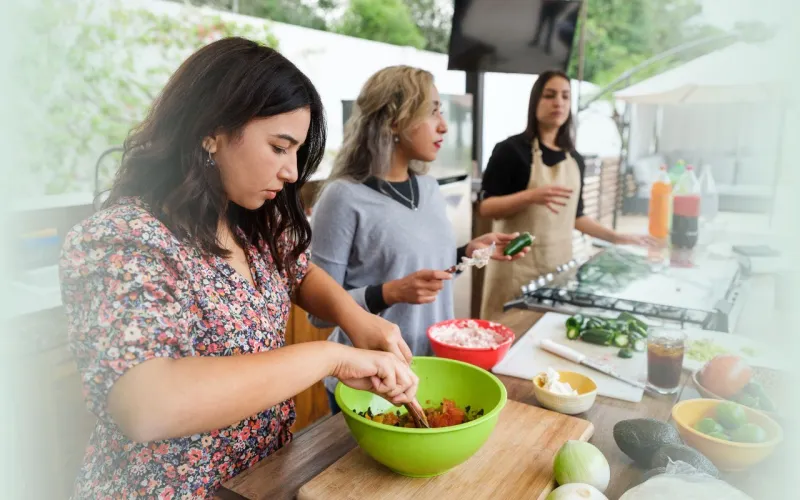
There's a particular kind of magic that happens when a Guatemalan grandmother teaches a Somali teenager how to make tamales, and the teenager brings her own spice blends to the table. It's unscripted, unsponsored, and deeply human. And more often than not, there's someone behind the scenes who quietly set the whole thing up — someone who reserved the kitchen space, sent the flyers in four languages, and made sure everyone felt genuinely welcome walking through the door.
These are the community organizers, cultural liaisons, and neighborhood connectors doing the slow, unglamorous, and absolutely essential work of making multicultural America actually function. They don't usually make headlines. But their fingerprints are all over the communities that feel alive.
Chicago's "Third Space" Strategy
In Chicago's Albany Park neighborhood — one of the most linguistically diverse zip codes in the entire country — organizer Marisol Reyes has spent the last eight years building what she calls "third spaces." Not home, not work, but somewhere in between. A place where your cultural identity is an asset, not something to quietly tuck away.
"People come to a neighborhood and they find their own community, which is beautiful," Reyes explains. "But if you never have a reason to step outside that bubble, you start to see the other communities around you as strangers. And strangers become threats. That's not inevitable — it's a design problem."
Her solution? Intentional overlap. Her organization hosts monthly "skill share" nights where residents teach each other something — a recipe, a craft, a song, a language phrase. The catch: you have to attend at least one session from a culture other than your own before you can host one. It sounds simple. It works remarkably well.
"We had a Korean family and a Puerto Rican family who'd lived on the same block for six years and never really talked," she says, laughing a little. "They ended up co-hosting a night about fermentation — kimchi and curtido side by side. Now they're basically best friends."
Miami's Multilingual Connectors
Down in Miami, the cultural complexity is a whole different kind of layered. You've got Cuban-American families who've been there for generations, newer arrivals from Venezuela and Haiti, a growing Brazilian community in Brickell, and longtime Black Miami residents whose stories often get drowned out by the louder immigration narratives. Keeping all of those voices in the same room — and making sure none of them dominate — is basically a full-time job.
That's exactly what it is for cultural liaison Thierry Augustin, who works with a coalition of neighborhood associations across Liberty City and Little Haiti. His focus is on what he calls "narrative equity" — making sure that when a neighborhood's story gets told, it's not just one community's version of it.
"Miami has this reputation as a Latin city, and that's real, but it flattens everything," Augustin says. "The Haitian community has been here for decades. The Bahamian community even longer. When we only celebrate one story, we're erasing people. And erased people don't show up to community meetings. They don't trust the process."
His approach involves co-producing neighborhood events where the planning committee itself is deliberately cross-cultural — not just diverse in attendance, but diverse in decision-making. The difference, he insists, is everything. "Anybody can invite people to a party. It's another thing entirely to let them help plan it."
Portland's Unexpected Coalitions
Portland, Oregon has a complicated relationship with its own diversity. The city's progressive reputation often bumps up against a history of exclusionary housing policies and a demographic makeup that's still catching up to its ideals. But in the Jade District — a stretch of Southeast Portland anchored by long-established Asian American businesses — organizer Yuki Tanaka-Morrison has been quietly building coalitions that cross generational and ethnic lines in ways that surprise even her sometimes.
Her current project pairs East African youth with Japanese American elders for oral history documentation sessions. The teenagers interview the elders, record their stories, and then present them at community events. What started as a cultural preservation effort has turned into something much more reciprocal.
"The elders started asking the kids about their lives too," Tanaka-Morrison says. "About what it's like navigating American schools, about music they listen to, about what their parents worry about. It became this genuine exchange. Nobody expected that."
She's careful to note that the goal was never to manufacture some feel-good multicultural moment. "Tokenism is exhausting and people can smell it from a mile away," she says bluntly. "We're trying to build actual relationships. That takes time and it takes honesty about where the tensions are, not just celebrating the pretty parts."
The Hard Parts Nobody Talks About
Every organizer we spoke to was quick to acknowledge that this work is not all tamale-making and friendship bracelets. Building genuine cross-cultural community means navigating real disagreements — about religion, gender roles, political history, and who gets resources. Avoiding those conversations in the name of keeping things "positive" is, as Reyes puts it, "just a slower way of failing."
"We've had events where things got tense," she admits. "Where someone said something that landed wrong, where old wounds came up. And honestly? Sometimes that's the most productive thing that can happen, if you have the infrastructure to hold it."
That infrastructure — trained facilitators, clear community agreements, follow-up processes — is what separates sustainable bridge-building from one-off feel-good events. It's also what makes this work expensive and difficult to fund. Most of these organizers are piecing together grants, small donations, and sheer personal commitment to keep things running.
Why This Work Matters More Than Ever
In a political climate where immigration, identity, and belonging are flashpoints, the work of community organizers like Reyes, Augustin, and Tanaka-Morrison isn't just nice to have — it's load-bearing. The neighborhoods where people actually know each other across cultural lines are more resilient. They push back harder against displacement. They show up for each other during crises.
And they tend to produce something that's genuinely hard to manufacture from the top down: the kind of lived, embodied pluralism where difference feels like richness rather than threat.
The mosaic doesn't build itself. Somebody lays each tile, thoughtfully, one piece at a time. And right now, in cities across this country, those somebodies are showing up — underfunded, underrecognized, and absolutely essential.