Thread by Thread: The Artisans Stitching Heritage Into the Future of American Fashion
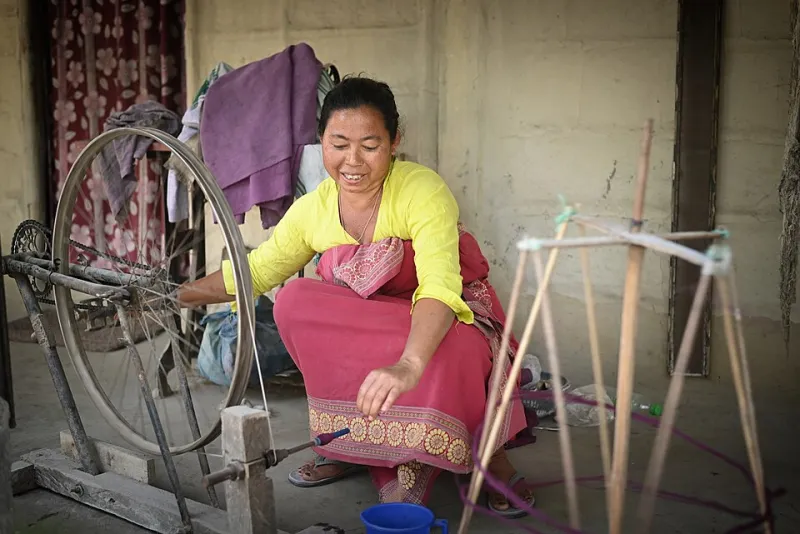
Photo: পৱন বৰ্মন, CC BY 4.0, via Wikimedia Commons
Walk into the right boutique in Brooklyn, browse the right vendor booth at a cultural festival in Los Angeles, or stumble across the right Instagram shop run out of a living room in Houston, and you might find yourself holding something that stopped you cold. Not because of a logo. Not because of a trend. But because the object in your hands feels like it came from somewhere real.
That's the quiet power of the traditional textile movement taking root across the United States right now — and it's growing faster than most people realize.
When Your Grandmother's Loom Becomes Your Business Plan
For Marisol Ajú, a Guatemalan-American designer based in Los Angeles, the path to building her textile brand didn't start with a fashion school application. It started with watching her mother work a backstrap loom in their apartment in Koreatown, replicating the huipil patterns she'd learned as a girl in Quetzaltenango.
"I grew up thinking that what my mom did was just something we kept inside the house," Marisol says. "It took me years to understand that what she was doing was extraordinary — that she was carrying something irreplaceable."
Today, Marisol's label sources hand-woven fabric directly from a cooperative of Maya weavers in Guatemala, incorporating those textiles into contemporary silhouettes designed specifically for the American market. Blazers with traditional huipil panels. Tote bags lined with hand-embroidered fabric. Throw pillows that belong in a design magazine but carry a story that goes back generations.
Hers is not a singular story. Across the country, immigrant artisans and second-generation designers are doing the same kind of work — pulling traditional techniques out of the private sphere and into public commerce, with remarkable results.
More Than Aesthetics: The Economics Behind the Movement
There's a real economic engine underneath all of this beauty. When designers like Marisol build supply chains that run back to artisan cooperatives in their home countries, they're not just creating beautiful products — they're routing money into communities that desperately need it.
The global artisan economy is estimated to be worth over $100 billion, and a growing slice of that market is being driven by diaspora entrepreneurs in the US who have figured out how to bridge cultural authenticity with American consumer appetite. Fair-trade certification, direct-trade relationships, and transparent sourcing have become selling points that resonate strongly with buyers who are increasingly skeptical of fast fashion's human cost.
Shops like Salone Moyo in Chicago, which specializes in contemporary homeware incorporating West and East African textile traditions, or Neysha Sima's embroidery-forward clothing line rooted in Oaxacan bordado technique, are building loyal customer bases not just within their own communities but across a broader demographic of design-conscious Americans who want their purchases to mean something.
"People are exhausted by disposable stuff," says textile researcher and cultural consultant Priya Anand, who studies immigrant craft economies at a New York-based think tank. "There's a real hunger for objects that have a story — that were made slowly, by someone who cared, using a technique that took years to learn. Traditional textiles offer all of that in a single piece."
Authenticity Is the Hard Part
But scaling a craft without losing its soul is genuinely difficult work, and the most thoughtful practitioners will tell you that openly.
The tension between growth and authenticity is real. When a hand-embroidered piece takes forty hours to make, how do you price it fairly without pricing out your own community? When mainstream retailers come calling — and they do come calling — how do you protect the cultural meaning embedded in your patterns from becoming just another print in a fast-fashion rotation?
Several designers point to the ongoing issue of cultural appropriation in the fashion industry as both a cautionary tale and a motivating force. When large retailers have lifted indigenous textile patterns without credit or compensation, the backlash has been swift and deserved. That history has made many artisan-entrepreneurs fiercely protective of their supply chains and intentional about education.
"Every piece I sell comes with a card that explains the technique, where it comes from, and who made it," says Yewande Okafor, a Nigerian-American designer in Atlanta whose label incorporates aso-oke weaving into modern womenswear. "I want the person buying it to understand what they're holding. That context is part of the product."
The Consumer Shift That's Making All of This Possible
None of this movement would be gaining momentum without a meaningful shift in how American consumers think about what they buy and wear. The slow fashion movement, the push for ethical sourcing, and a broader cultural reckoning with representation have all converged to create an audience that is genuinely ready for what these designers are offering.
Social media has been a significant equalizer here. Platforms like Instagram and TikTok have allowed small artisan brands to reach national audiences without the gatekeeping of traditional retail. A weaver in a suburb of Minneapolis can sell directly to a customer in Miami who discovered her work through a thirty-second video of her loom in motion. The intimacy of that connection — watching someone's hands at work, hearing them explain the origin of a pattern — builds a kind of trust that no billboard can manufacture.
Buyers are also increasingly willing to pay for that trust. Research consistently shows that younger American consumers, particularly millennials and Gen Z, are more likely to spend more on a product they believe was made ethically and with cultural integrity than on a cheaper alternative with an opaque supply chain.
A Mosaic in Motion
What's emerging across American fashion and home design right now is something genuinely exciting — a living mosaic of textile traditions from every corner of the world, being reinterpreted and reimagined by people who carry those traditions in their hands and their histories.
It's Hmong paj ntaub needlework appearing on gallery walls in St. Paul. It's Peruvian pallay weaving patterns showing up in the throw blankets of design-forward home goods shops in Portland. It's a young Senegalese-American woman in Philadelphia teaching weekend workshops on wax print fabric construction to anyone who wants to learn.
These aren't novelties. They're not trends. They're the result of generations of knowledge being carried across oceans and borders and apartment thresholds, finally finding a wider audience that has the sense to recognize what it's looking at.
The American textile renaissance isn't being led by fashion houses or trend forecasters. It's being led by people who learned at their mothers' knees, who refused to let those lessons go quietly, and who are now, thread by thread, weaving something new into the fabric of this country.
And honestly? It looks incredible.