What Grandma Knows: The Immigrant Kitchens Holding Centuries of Culture Together
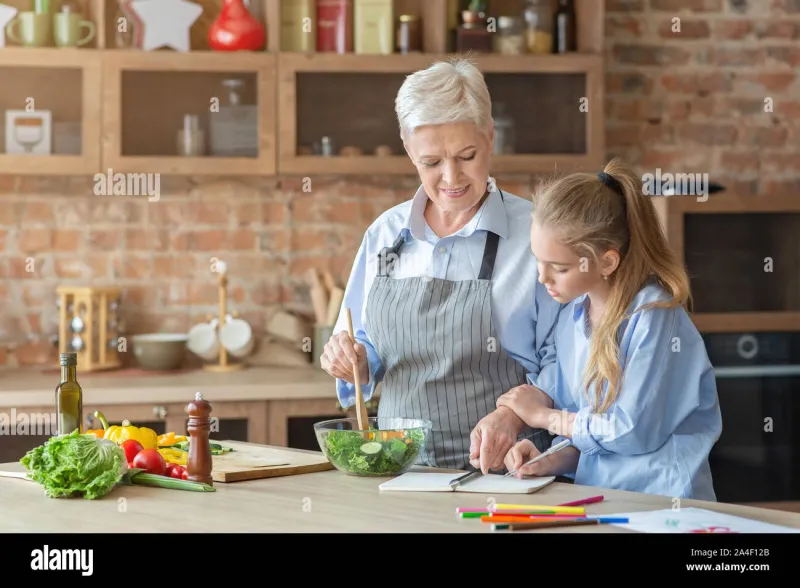
Photo: elderly immigrant grandmother teaching granddaughter cooking in kitchen, via c8.alamy.com
There's no written recipe. There never was. The dough gets kneaded until it "feels right." The spices go in by smell. The fire stays low "like your grandfather liked it." For millions of immigrant families across the US, this is how knowledge has always traveled — not through cookbooks or cooking shows, but through the warm, flour-dusted hands of a grandmother who learned from her grandmother, who learned from hers.
These women aren't just cooking. They're curating. And what they hold in their kitchens is nothing short of a living archive.
More Than a Meal
When Maya Osei, a 26-year-old graphic designer in Atlanta, started filming her Ghanaian grandmother making kontomire stew, she wasn't thinking about preservation. She just wanted to remember.
"My grandmother doesn't measure anything," Maya laughs. "She'll say 'a little of this' and it's like half the jar. I started recording her because I was terrified that one day I'd try to make it and have no idea what I was doing."
What began as a personal project turned into something much bigger. Maya's videos — raw, unedited, shot on her phone while her grandmother narrated in Twi and broken English — started circulating in Ghanaian American Facebook groups. Strangers from Houston to Minneapolis were tagging their own grandmothers, sharing similar stories. The comments filled up fast: My yaya does the same thing. My lola refuses to write anything down. We've been trying to get my abuela to let us film her for years.
It turns out Maya wasn't alone in her quiet panic.
The Knowledge That Doesn't Translate
Food scholars have a term for what these grandmothers carry: tacit knowledge. It's the kind of understanding that lives in the body rather than the brain — in the pressure of a palm testing bread dough, in the sound of oil that's exactly hot enough, in the instinct to add a pinch more of something without being able to explain why.
This knowledge is notoriously difficult to transfer. You can write down "simmer until reduced," but you can't write down what that looks like after forty years of practice. You can list ingredients, but you can't list the regional variation your great-grandmother made because that particular dried herb only grew near her village and she's been improvising with what's available in American grocery stores ever since 1987.
That improvisation, too, is part of the archive. It tells a story of migration, of scarcity, of adaptation — of what it means to cook your culture in a country that doesn't always stock your ingredients.
"My mother-in-law makes a version of mole that her mother made in Oaxaca, but she's been substituting certain chiles for decades because she can't always find the originals here in Chicago," says food writer and community organizer Daniela Reyes. "That substitution is history. It's the history of her immigration. If we only try to document the 'authentic' version, we lose the real story."
Racing Against Time
The urgency here isn't abstract. As first-generation immigrant grandmothers age, entire culinary lineages sit at risk of simply ending. Unlike folk songs or textile patterns, food knowledge is especially fragile — it requires active, repeated practice to survive, and it often lives in only one or two people at a time.
Some communities are moving to change that. In the Bay Area, a nonprofit called Nourish the Roots has been running intergenerational kitchen documentation workshops for Southeast Asian families, pairing elderly women with younger relatives and trained archivists to create detailed video and written records of their cooking. Participants get a USB drive with their family's footage at the end. The organization keeps a copy in its growing digital library.
In New York, a Bangladeshi community center in Jackson Heights has been hosting monthly "grandmother sessions" where older women cook together while younger members observe, ask questions, and take notes. What started as a social event has turned into an informal oral history project, with dozens of hours of footage now stored and catalogued.
"We realized we were sitting on gold and we didn't even know it," says one of the organizers. "These aunties and grandmothers are encyclopedias. They know which dish is made for mourning and which one is made for celebrating a boy's first haircut. They know which herb settles a stomach and which one you bring to a neighbor when they're sick. That's not just food knowledge. That's cultural infrastructure."
The Tension at the Table
Not every grandmother is thrilled about being documented, though. Some resist the camera entirely. Others worry their cooking will be judged, compared, or — perhaps worst of all — simplified into a recipe that strips away everything that makes it theirs.
"My grandmother was suspicious at first," admits Priya Nair, a second-generation Indian American in Houston who spent two years gently convincing her paati to let her film in the kitchen. "She kept saying, 'What's the point? You can just look it up online.' She didn't understand that what she does isn't on the internet. There's no video of the way she makes her particular version of rasam. It's hers."
There's also the complicated question of authenticity — a word that can carry as much baggage as it does meaning. Younger generations documenting these kitchens often find themselves navigating a delicate tension: honoring the original while acknowledging that adaptation is itself a form of cultural vitality, not a betrayal of it.
"Food is never frozen in time," says Daniela Reyes. "It moves. It changes. The grandmothers know this better than anyone — they've been adapting their whole lives. What we're preserving isn't a static dish. We're preserving a way of thinking about food, a relationship to ingredients, a set of values about what cooking is for."
Passing It On
For Maya in Atlanta, the project has become something she didn't expect: a way of getting to know her grandmother as a full person, not just a family fixture.
"Filming her made me ask questions I'd never thought to ask," she says. "Like, where did she learn to cook? What did she make when she was sad? What did food mean to her when she was growing up? I found out things about her life I had no idea about. The kitchen opened up a whole conversation."
That might be the most powerful thing about these documentation efforts — they don't just preserve recipes. They recover relationships, restore dignity, and remind families that the person standing at the stove has been carrying something precious all along.
The museum was always there. We just had to pull up a chair and pay attention.
Know a grandmother whose kitchen deserves to be documented? Tag us @themosaichub and tell us her story.